
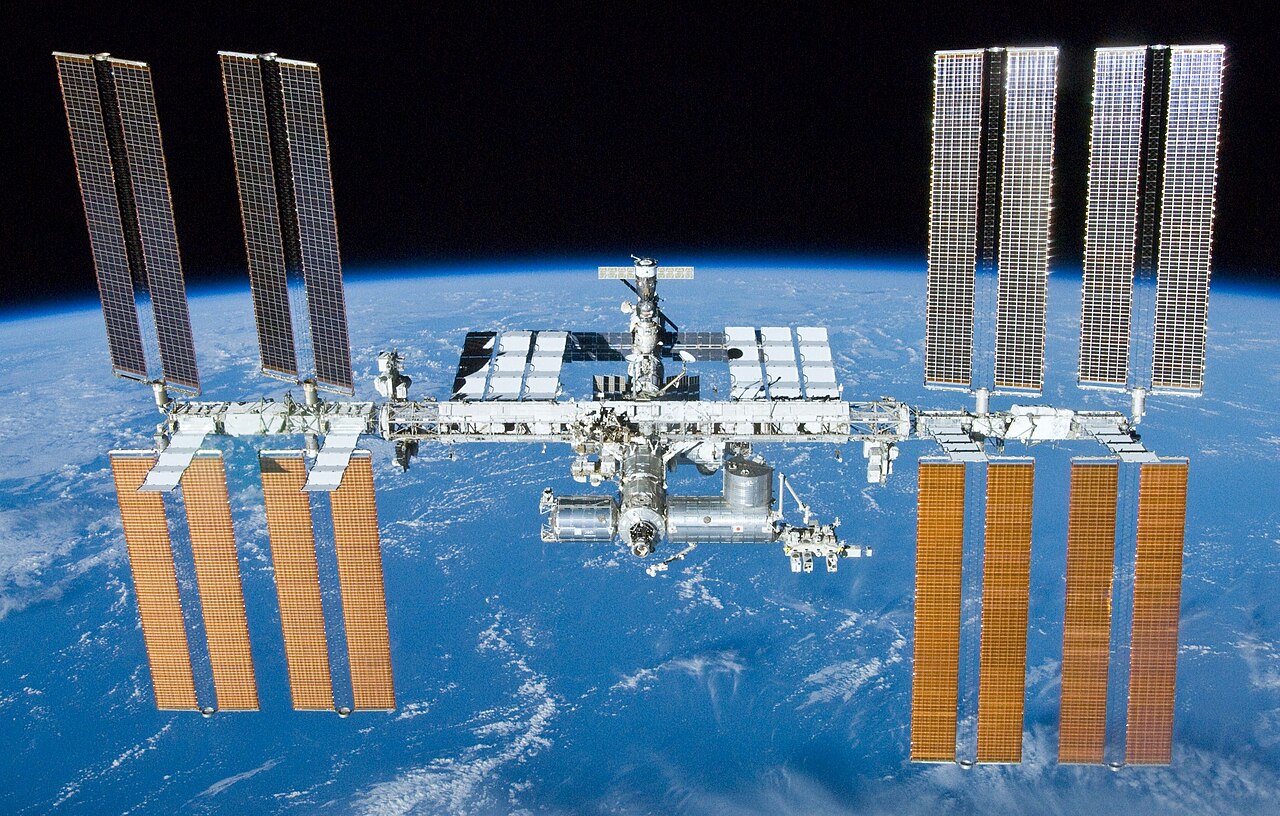
The International Space Station (ISS) combines NASA’s Space Station Freedom project with the Russian Mir-2 station, the European Columbus station, and the Japanese Kibō laboratory module.[43] NASA originally planned in the 1980s to develop Freedom alone, but US budget constraints led to the merger of these projects into a single multi-national program in 1993, managed by NASA, the Russian Federal Space Agency (RKA), the Japan Aerospace Exploration Agency (JAXA), the European Space Agency (ESA), and the Canadian Space Agency (CSA).[44][45] The station consists of pressurized modules, external trusses, solar arrays and other components, which were manufactured in various factories around the world and launched by Russian Proton and Soyuz rockets, and the American Space Shuttle.[43] The on-orbit assembly began in 1998, the completion of the US Orbital Segment occurred in 2009 and the completion of the Russian Orbital Segment occurred in 2010. The ownership and use of the space station is established in intergovernmental treaties and agreements,[46] which divide the station into two areas and allow Russia to retain full ownership of the Russian Orbital Segment (with the exception of Zarya),[47][48] with the US Orbital Segment allocated between the other international partners.[46]
The station can be seen from the Earth with the naked eye and, as of 2026, is the largest artificial satellite in Earth orbit with a mass and volume greater than that of any previous space station.[53] The Russian Soyuz and American Dragon and Starliner spacecraft are used to send astronauts to and from the ISS. Several uncrewed cargo spacecraft provide service to the ISS; they are the Russian Progress spacecraft which has done so since 2000, the European Automated Transfer Vehicle (ATV) since 2008, the Japanese H-II Transfer Vehicle (HTV) since 2009, the (uncrewed) Dragon since 2012, and the American Cygnus spacecraft since 2013.[54][55] The Space Shuttle, before its retirement, was also used for cargo transfer and would often switch out expedition crew members, although it did not have the capability to remain docked for the duration of their stay. Between the retirement of the Shuttle in 2011 and the commencement of crewed Dragon flights in 2020, American astronauts exclusively used the Soyuz for crew transport to and from the ISS.[56] The highest number of people occupying the ISS has been thirteen; this occurred three times during the late Shuttle ISS assembly missions.[57]