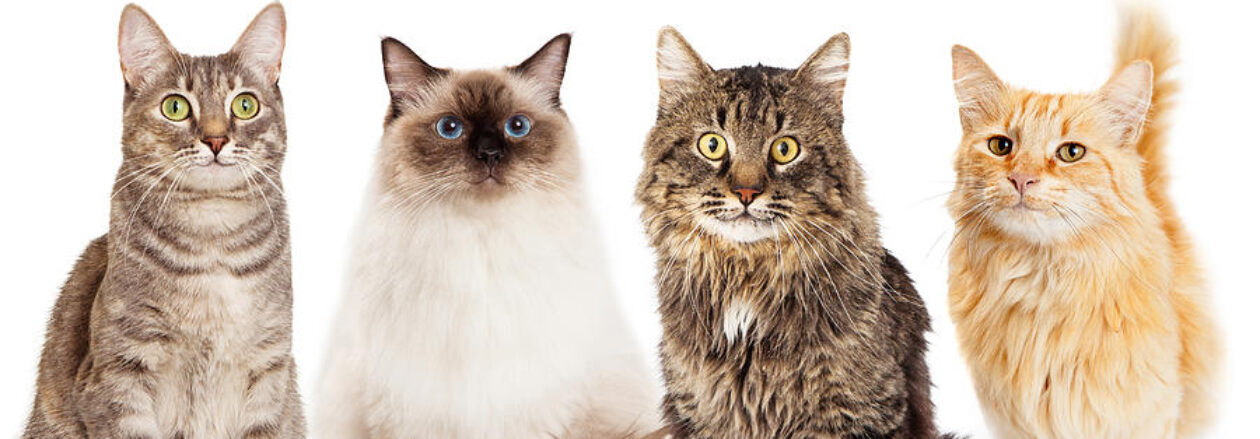
The social behavior of the domestic cat ranges from widely dispersed individuals to feral cat colonies that gather around a food source, based on groups of co-operating females.[104][105] Within such groups, one cat is usually dominant over the others.[106] Each cat in a colony holds a distinct territory, with sexually active males having the largest territories, which are about 10 times larger than those of female cats and may overlap with several females’ territories. These territories are marked by urine spraying, rubbing objects at head height with secretions from facial glands, and by defecation.[87] Between these territories are neutral areas where cats watch and greet one another without territorial conflicts. Outside these neutral areas, territory holders usually chase away stranger cats, at first by staring, hissing, and growling, and, if that does not work, by short and violent, noisy attacks. Because cats do not have a social survival strategy or herd behavior, they always hunt alone.[107]
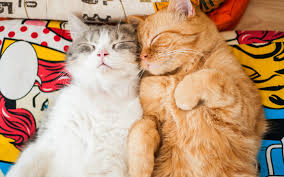
Two kittens resting side by side, an instinctive behavior that offers both protection and comfort
Two kittens lying side by side, an instinctive behavior that offers both comfort and protection
Life in proximity to humans and other domestic animals has led to a symbiotic social adaptation in cats, and cats may express great affection toward humans or other animals. Ethologically, a cat’s human keeper functions as a mother surrogate.[108] Adult cats live in a type of extended kittenhood, a form of behavioral neoteny. Their high-pitched sounds may mimic the cries of a hungry human infant, making them particularly difficult for humans to ignore.[109] Some pet cats are poorly socialized. In particular, older cats may show aggressiveness toward newly arrived kittens, which includes biting and scratching; this type of behavior is known as feline asocial aggression.[110]

Redirected aggression is a common form of aggression that can occur in multiple cat households. In redirected aggression, a cat is usually agitated by a stimulus such as a sight, sound, or other trigger that causes heightened anxiety or arousal; if the cat cannot attack the original stimulus, it may redirect its aggression toward the nearest cat, pet, human, or other being.[111][112]
Domestic cats’ scent rubbing behavior toward humans or other cats is thought to be a feline means of social bonding.[113]